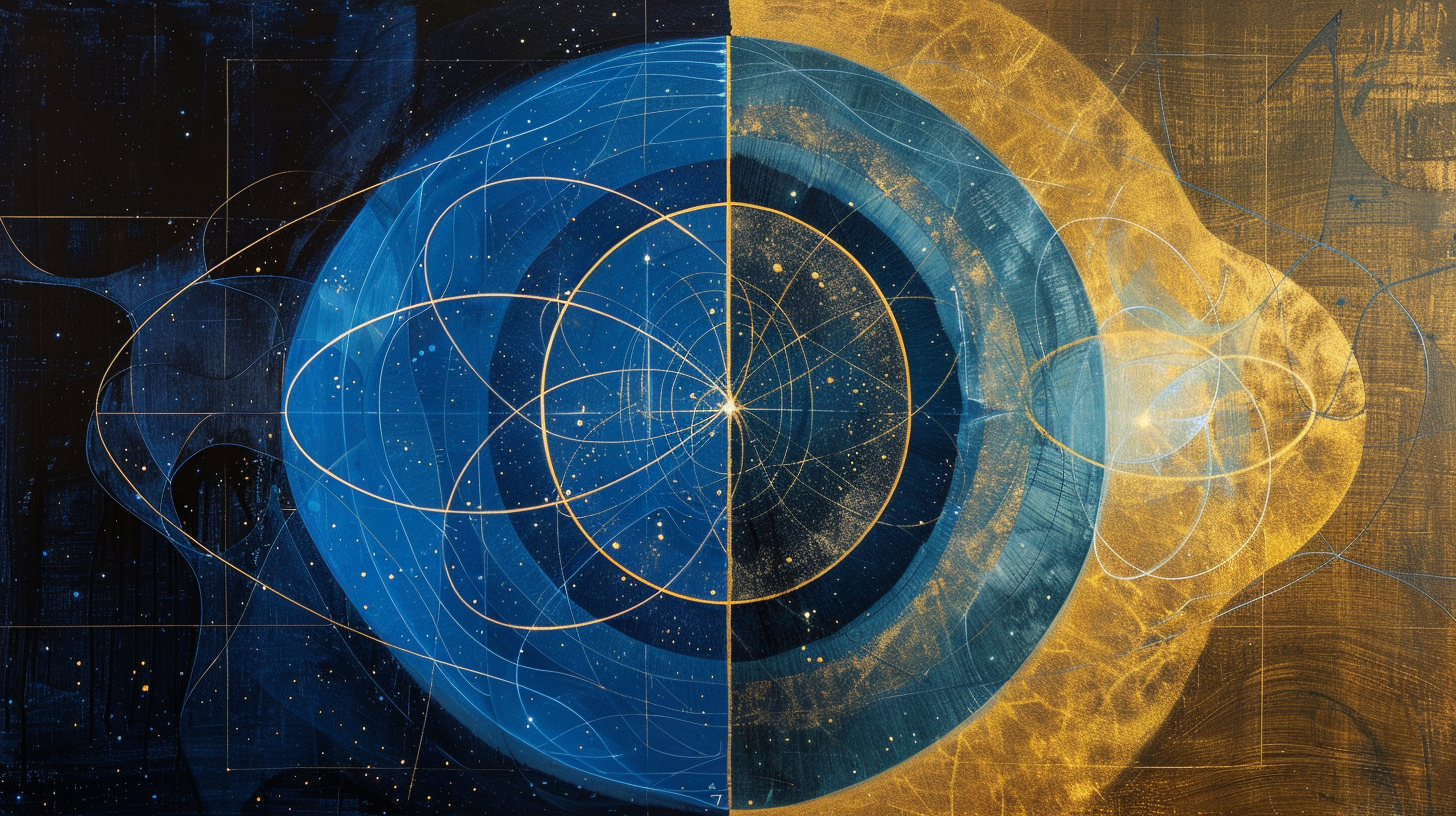
Time Beyond the Tick of the Clock: A Personal Prelude
I remember sitting for long hours in the shrine of Imam Ali (a.s.), night after night, beneath the awe-inspiring architecture and whispered prayers. Yet it never felt long. Time didn’t pass, I wasn’t counting minutes; I was being unmade and remade by presence. The shrine didn’t offer an escape from time; it offered a realignment. I wasn’t outside of time, but inside a different rhythm altogether. The resonance of that space was not measured but lived.
I’ve also felt this paradox in more fragile, physical spaces. On the C-section table, as I lay under bright surgical lights, there was a moment, perhaps seconds, perhaps centuries, where time left the room. Not clock time, but something else. I was suspended. Alert but floating. As though time had paused just enough to let another life pass through.
These moments, whether drenched in prayer or pain, do not register on our clocks. They are not mechanical. They are more akin to what the French philosopher Henri Bergson called durée: time not as quantity, but as quality. Not ticked, but tasted.
Read “The Pragmatic Truth of Existentialism”
Clockwork and Its Limits
The measurement of time, as precise as it appears, is ultimately relative, tied not to some absolute essence, but to the behavior of physical systems. Today, a “second” is defined by 9,192,631,770 oscillations between two hyperfine energy levels of the cesium-133 atom.
But this definition is not absolute; it is a convention based on the reliability of a particular atomic transition. What if, under extreme conditions or at the edge of physical laws, the transition between those energy levels were to cease? Does time stop? Or does it continue without a means to measure it? This exposes a deeper truth: our notion of time is inseparable from the phenomena we use to track it. In the absence of such a phenomenon, what remains of time may no longer be measurable, but not necessarily non-existent.
The measurement of time is fundamentally relative, a pragmatic way but not the absolute way.
Today, it’s the cesium-133 atom; tomorrow, it may be a more precise element or quantum event. Since our goal is ever finer precision, time is treated not as an entity in itself, but as a parameter, a condition that allows us to measure change in other systems. Yet time itself remains intangible, almost evasive. We refine our clocks, but we do not get closer to time’s essence. It serves as the backdrop for other measurements, yet resists being measured in any final sense. To speak of time is to enter a realm where language starts to blur and the mind begins to boggle.
In an era obsessed with acceleration, we are haunted by a paradox: though we can now measure time down to the nanosecond, we have never been more estranged from it. We carry clocks on our wrists and in our pockets, yet we rarely feel at home in time. We speak of “losing time,” “wasting time,” “running out of time”—as though time were something external, elusive, even adversarial.
And yet, for all our precision, the concept of time remains strangely loopy and elusive. Is it a line? A cycle? A dimension? A memory? Even our most scientific definitions strain under the weight of experience. Time is at once the most familiar and the most mysterious condition of our existence.
What if this tension—between measurable time and meaningful time—is not merely intellectual, but spiritual?
This is where two unlikely traditions converge. Henri Bergson and the metaphysical vision of Shia Islam both offer a way of reimagining time—not as a neutral backdrop to events, but as a living, sacred force. They do not simply measure time; they seek to illumine it. And in a world governed by clocks yet starved for presence, their insights may be more urgent now than ever.
Read “Look for Things That Don’t Change”
A Spiritual Map of Time: Bergson and Shia Islam
In Shia metaphysics, time is not monolithic. It unfolds across three ontological dimensions: zamān, the empirical time of clocks and calendars; dahr, an eternal, archetypal time; and sarmad, the timelessness of the divine. This triadic model reflects a vertical cosmology, ascending from the temporal to the eternal.
Zamān is familiar: the domain of birth and death, history and change. It is the time we inhabit daily. But above it lies dahr—a kind of imaginal eternity where divine archetypes reside, unbounded by sequential progression. At the summit is sarmad, the timeless realm of God’s absolute presence, where all is “now.” These layers of temporality are not just conceptual—they shape Shia views of the cosmos, prophecy, and salvation.
Henri Bergson, too, challenged the idea that time is merely something to be measured. In his concept of la durée, or duration, he described a lived, qualitative time—a flowing consciousness where past and present interpenetrate. Time, for Bergson, is not what clocks count but what life feels. It is inward, intuitive, and indivisible.
Read “Humans Are Not Merely Algorithms”
Paradise and Eternal Youth: Suspended Time in the Eschaton
In the Qur’anic vision of Paradise, time is suspended in a state of perfection. Inhabitants do not experience aging or decay: “They will remain therein forever, never experiencing change or aging.”
This suggests a form of timelessness, where time ceases to progress in a linear, measurable way. Instead, it becomes a continuous, indivisible present. This aligns with Henri Bergson’s concept of durée, where time is lived as an unbroken flow.
In Shia metaphysics, this state mirrors dahr, an eternal realm where spiritual realities remain whole and unchanging. Both frameworks present Paradise as a time beyond chronological measurement—a sacred, perfected duration where presence is complete and timeless. If the paradise suspends time, then the cave bends it–revealing a temporality that obeys divine will, not mechanics.
Read “Play Is the Metaphysics of Becoming”
The Cave and the Clock: Sacred Time in Cave and Shrine
Perhaps no story illustrates this sacred temporality better than the Qur’anic narrative of the Ahl al-Kahf (People of the Cave). Seeking refuge from persecution, these young believers fall asleep in a cave for centuries, unaware of the passing of time. When they awaken, the world has changed, but they have not aged. Chronology has passed them by, yet they remain anchored in divine mercy.
This tale is more than a miracle—it is a meditation on time itself. The companions of the cave are suspended within dahr, protected from the linear progression of zamān. They become symbols of how divine will can hold time still, or bend it entirely.
Bergson might see this suspension of time as a moment of pure durée—where time is not external but interior, not measured but lived. The Ahl al-Kahf dwell in a pocket of sacred time, where the soul is untouched by decay, and the divine remains near.
In many ways, my nights in the shrine of Imam Ali (a.s.) were my cave.
Not in the metaphysical sense of suspended centuries, but in the experiential sense of refuge—of being held outside the pressures of measured life. Just as the companions of the Cave stepped outside history’s relentless tick, I too, in that sacred space, stepped outside the calendar that had been assigned to me. Outside, in the “real” world, I lived by a calendar I didn’t choose: a job by 27, a car by 28, married before 30, a child by 31. Time was fragmented into milestones I was expected to meet—pre-scripted deadlines imposed on life’s unfolding. These expectations came with their own quiet violence, burdening me with a kind of existential clockwork. Every year had to deliver something tangible: a possession, a position, a performance. There was no room to simply be.
In the shrine, that script dissolved. There was no ticking clock. No race. No expectation. Only presence, like the hush that wrapped the young sleepers in the cave, holding them still while the world turned. But in that shrine, I encountered another temporality—one that didn’t measure me, didn’t require me to prove or produce. I wasn’t failing or succeeding. I was just alive. And I was content.
That contentment is what I wanted to bottle. Not like a relic, but like a perfume—something I could carry into the restless corridors of everyday life. A reminder that time is not always a race, and that sacredness often arrives when we fall out of step with the ticking world.
The shrine didn’t rescue me from time. It rescued me from the version of time that fractures our lives into anxious metrics. For a moment, I was not climbing toward a goal—I was immersed in a presence. That is what I still long to carry: not the timeline I’m told to follow, but the sacred rhythm that once whispered, simply, live.
This is what Henri Bergson called durée—duration not as a string of moments, but as a continuous unfolding of consciousness, thick with feeling and indivisible by measurement. In the Shrine, I wasn’t counting time; I was inhabiting it. The shrine didn’t stop time. It returned me to a deeper kind of time—a lived time, not made of seconds but of breath, warmth, nearness, and stillness. Bergson’s durée is not abstract in such moments; it is what the soul knows before the clock interrupts. In that sacred space, I knew it too.
To live with this awareness is to recognize that we are not adrift in meaningless chronology. We are being drawn, quietly but surely, by a presence that knows us, that guides the pulse of time from beyond its surface. Time is not empty. It is inhabited.
Read “A Community of Consciousness: Bridging the Gap Between Mind and Matter”
Epilogue: Towards the Sacred Phenomenology of Time
Both Shia metaphysics and Bergson’s philosophy invite us to reimagine time—not as a sterile sequence of moments, but as a living reality saturated with presence. For Bergson, time (durée) is the rhythm of inner life, irreducible to clocks and calendars. For Shia thought, time is layered and alive.
This convergence opens a bold metaphysical horizon: What if the flow of time is not blind, but guided? What if true temporality involves a kind of sacred intimacy—a nearness to the divine that unfolds within and beyond lived moments?
By bringing these two traditions into conversation, we glimpse a deeper phenomenology of time, one that resists flattening existence into mechanical succession, and instead gestures toward an inner continuity animated by presence, consciousness, and grace. In such a vision, the human task is not merely to measure time, but to inhabit it, to listen, not for the tick of a clock, but for the pulse of the Real echoing within its flow.
While modern science defines time through the steady oscillations of the cesium-133 atom, using its hyperfine transitions to mark each second with extraordinary precision—this measurement is, at its core, a human arrangement, a framework we’ve built to orient ourselves within the material world.
We’ve wrapped our days and nights, our calendars and civilizations, around this construct, revolving our entire sense of order around it. But when God speaks of time “on the first day, this was created,” “on the sixth day, creation was completed”—we are confronted with an entirely different register of time. Surely, the divine does not count days by cesium vibrations or Earth’s rotation. These “days” could mark epochs, stages of becoming, or timeless commands, rather than units measurable by our instruments.
This exposes a deeper truth: our scientific concept of time is not universal, but contextual. When we speak of sacred time—whether in scripture, spiritual experience, or mystical insight—we invoke a different ontology of time, one that transcends precision and points toward meaning, presence, and transcendence. The challenge, then, is to recognize that not all time is measured in seconds; some is measured in depth, revelation, or becoming.
In the end, we must ask: What truly drives the rhythm of our lives? Is it the tick of the clock, the acceleration of deadlines, the nanosecond pulses of a cesium atom? Is our purpose measured by timelines and milestones, or by presence and becoming? If we let our calendars script our existence, we may forget how to dwell in time, not pass through it, but abide within it. Time was never meant to be chased, but listened to. Not counted, but lived.

Sabahat is an educator and writer based in Kashmir, holding a master’s degree in both zoology and philosophy, which grounds her work at the crossroads of science and the humanities. Her essays have appeared in MetaPsychosis, Interalia, The Wire, and Daily Philosophy, and are forthcoming in Polyphony.
Her intellectual focus lies in bridging metaphysics, religious thought, and philosophical inquiry—particularly where concepts of time, consciousness, and the sacred intersect.



Leave a Reply